As a lead psychologist teaching Sports Psychology at the University of Ghana, I watched Ghana’s FIFA World Cup encounter against England with great interest. While many football fans focused on tactics, possession statistics, and individual performances, I was equally fascinated by the psychological qualities displayed by the Black Stars throughout the match.
The goalless draw against England was not simply a football result. It was a demonstration of psychological strength, mental toughness, discipline, composure, and collective resilience. In many ways, the performance provided a valuable lesson about human behaviour, teamwork, and the power of belief when facing seemingly superior opposition.
Before the match, England were widely regarded as favourites. They possessed players from some of the biggest clubs in Europe, greater international exposure, and a squad valued far above that of Ghana. Yet football, like life, often reminds us that outcomes are not determined solely by resources, reputation, or status. The mental side of performance frequently plays an equally important role.
The Ghana-England draw therefore offers several important psychological lessons that extend beyond football and into workplaces, schools, organizations, communities, and everyday life. Below are five key psychological reflections that stood out during this memorable World Cup encounter.
Collective Efficacy: The Power of Shared Belief
One of the strongest psychological concepts demonstrated by Ghana during the match was collective efficacy.
The renowned psychologist Albert Bandura introduced the concept of collective efficacy, which refers to a group’s shared belief in its ability to achieve a desired goal. Unlike individual confidence, collective efficacy is built on the belief that the entire team can succeed when working together.
Throughout the match, Ghana’s players displayed this shared belief. They trusted one another, maintained discipline, and continued executing their game plan despite the pressure created by England’s attacking talent. There was a visible sense that every player believed the team could compete successfully regardless of what the pre-match predictions suggested.
This belief was particularly evident during difficult moments when England controlled possession and attempted to break through Ghana’s defensive structure. Rather than panic, the Black Stars remained organized and continued supporting one another. Such behaviour is often a sign of strong collective efficacy.
Research in organizational psychology consistently shows that teams with strong collective efficacy often outperform groups that may possess greater resources but lack unity and trust. Companies, departments, and project teams frequently achieve exceptional outcomes not because they have the most talent, but because members genuinely believe in their collective ability to solve problems together.
The Black Stars provided a perfect example of this principle in action. Their performance demonstrated that confidence shared across a group can become a powerful competitive advantage.
The Underdog Effect: Turning Doubt into Motivation
Another fascinating psychological factor that appeared to influence Ghana’s performance was what psychologists often describe as the “Underdog Effect.”
In many competitive situations, being underestimated can become a powerful source of motivation. Individuals and teams that are not expected to succeed often develop higher levels of determination, focus, persistence, and commitment.
Leading into the match, much of the international media focused on England’s strengths. Discussions centered on players such as Harry Kane, Jude Bellingham, Declan Rice, and Bukayo Saka. Many analysts predicted an England victory, while relatively few gave Ghana a realistic chance of securing a positive result.
However, being viewed as outsiders may have helped strengthen Ghana’s mindset.
When expectations are low, people are often freed from the pressure of protecting a reputation. Instead, they become focused on proving what is possible. This shift in mindset can unlock additional levels of effort and determination.
The Ghanaian players appeared to embrace this challenge. They ran tirelessly, defended aggressively, remained focused throughout the game, and showed a willingness to sacrifice personal recognition for the benefit of the team.
Meanwhile, England manager Thomas Tuchel deserves credit for not underestimating Ghana. His team selection and substitutions suggested that he understood the threat posed by the Black Stars. Yet while England respected Ghana, much of the external narrative continued to place the Three Lions comfortably ahead.
The Black Stars responded by demonstrating that belief and commitment can significantly reduce the gap between perceived favourites and underdogs.
Social Identity and National Pride
A third psychological factor that stood out during the match was the role of social identity.
The respected social psychologist Henri Tajfel argued that individuals derive confidence, motivation, and self-esteem from belonging to valued groups. This concept, known as Social Identity Theory, helps explain why people often perform beyond expectations when representing something larger than themselves.
The Ghanaian players were not simply playing for personal success. They were representing their families, communities, supporters, and an entire nation.
This sense of responsibility can generate powerful emotional energy.
Throughout the match, the players demonstrated commitment that went beyond tactical instruction. Every tackle, block, interception, and recovery run appeared driven by a deeper sense of purpose. They were defending not only a scoreline but also a national identity.
Psychological research consistently shows that people work harder when they strongly identify with a group or mission. Employees often become more productive when they believe in their organization’s purpose. Students frequently perform better when they feel connected to their school community. Athletes similarly elevate their performances when representing their country.
The Black Stars appeared energized by this sense of collective pride. In difficult moments, that emotional connection can provide the extra motivation needed to maintain concentration, effort, and discipline. Ghana’s players demonstrated exactly that against England.
Psychological Resilience Under Pressure
Perhaps the most impressive aspect of Ghana’s performance was the team’s resilience.
Resilience refers to the ability to adapt, recover, and continue pursuing goals despite setbacks, obstacles, or adversity. In elite sport, resilience is often what separates successful teams from unsuccessful ones.
The World Cup creates enormous pressure. Every decision, mistake, and opportunity carries significant consequences. Players are expected to perform while millions of people watch and evaluate their actions.
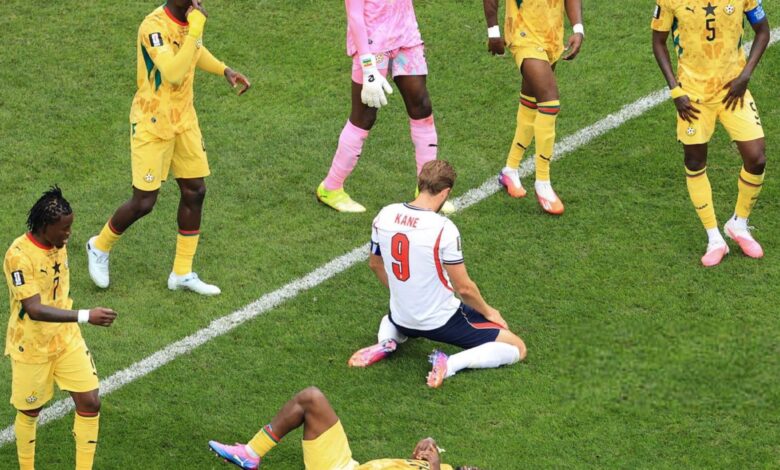
Against England, Ghana faced repeated periods of pressure. They had to defend for long stretches, absorb attacks from world-class players, and maintain concentration against one of the tournament’s strongest teams.
Despite these challenges, the Black Stars remained composed. They did not allow frustration, fatigue, or pressure to disrupt their organization. Instead, they continued following their tactical structure and supporting one another until the final whistle.
This resilience offers an important lesson beyond football. Success in life rarely comes from avoiding difficulties. Challenges are inevitable in careers, relationships, businesses, and personal development. What often matters most is how individuals respond when difficulties arise.
Ghana’s performance demonstrated that resilience is not about eliminating obstacles. It is about maintaining focus, adapting effectively, and continuing to move forward despite them.
Team Cohesion Over Individual Talent
One of the most important lessons from the match was the value of team cohesion.
Research in organizational and sports psychology repeatedly shows that highly cohesive teams often outperform collections of talented individuals who lack strong relationships and coordination.
Football frequently provides examples of this phenomenon.
Talent can produce moments of brilliance, but teamwork often determines final outcomes.
The Black Stars displayed excellent cohesion throughout the encounter. Players communicated effectively, covered for one another defensively, and worked collectively in both attack and defence.
From Antoine Semenyo to captain Jordan Ayew, every player appeared committed to the same objective. There was no visible focus on individual recognition. Instead, the emphasis remained firmly on collective success.
This unity enabled Ghana to compete successfully against opponents with greater individual reputations.
The lesson extends well beyond football. Businesses, institutions, and organizations frequently discover that teamwork, trust, communication, and shared goals are more important than individual brilliance alone.
The Black Stars reminded us that a united team can often achieve results that exceed expectations.
Growth Mindset and the Courage to Challenge Expectations
The final psychological lesson comes from the concept of growth mindset.
Psychologist Carol Dweck’s research suggests that people who believe abilities can be developed through effort, learning, and persistence tend to achieve greater success than those who view talent as fixed.
The Ghana-England result challenges assumptions about capability and potential.
Many observers looked at squad values, club affiliations, and international rankings before concluding that England held a clear advantage. While those factors are important, they do not tell the entire story.
A growth mindset encourages individuals and teams to focus on improvement, learning, and possibility rather than limitations.
The Black Stars approached the challenge believing they could compete, improve, and succeed despite external perceptions.
This mindset allowed them to perform with confidence rather than fear. The lesson is relevant to everyone. Current circumstances should never be confused with future potential. Progress is often achieved by those willing to challenge assumptions and continue developing despite obstacles.
Psychological Takeaway: Belief Can Bridge the Gap
The Ghana-England draw offers a powerful reminder that performance is influenced by much more than resources, reputation, or historical achievements.
The match highlighted the importance of collective efficacy, resilience, social identity, teamwork, and growth mindset. These psychological factors helped Ghana compete effectively against one of the tournament favourites and secure a valuable result.
In life, organizations, communities, and sport, people often focus excessively on what they lack. They worry about limited resources, insufficient experience, or perceived disadvantages. While such factors certainly matter, they do not determine outcomes on their own.
The Black Stars demonstrated that when people unite around a common purpose, trust one another, remain resilient under pressure, and believe in their collective ability, they can achieve outcomes that exceed expectations.
The scoreline may have been level, but the psychological lessons from Ghana’s performance were priceless. As Ghana showed against England, sometimes the greatest advantage is not what a team possesses but what a team believes.
Indeed, resources, reputation, and past achievements do not guarantee success. Collective belief, teamwork, resilience, and shared purpose can bridge even the widest gaps and transform what many consider impossible into something achievable.
In my next reflection, I will explore another fascinating aspect of the World Cup experience: the relationship between football results and the psychological wellbeing of supporters.
Share this: