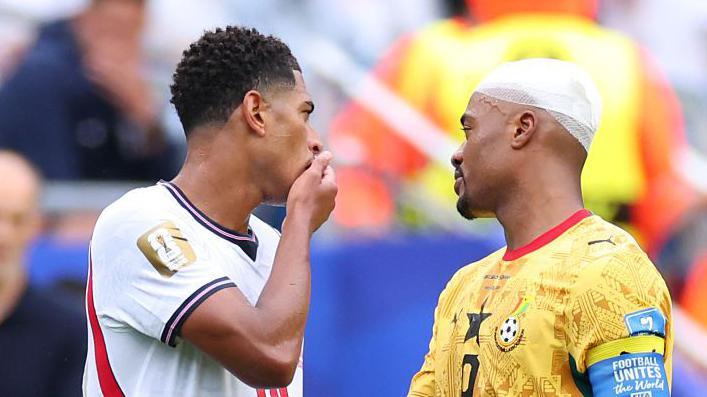
England midfielder Jude Bellingham became the focus of intense discussion during the 2026 FIFA World Cup after television cameras captured him covering his mouth while speaking to Ghana captain Jordan Ayew during the two nations’ goalless Group L draw in Boston.
The moment itself lasted only a few seconds, but it quickly generated widespread debate among football supporters, pundits, and social media users because of FIFA’s recently introduced regulations concerning players who conceal their mouths while communicating with opponents during confrontational situations.
With the tournament already witnessing the first dismissal under the new rule earlier in the competition, many viewers immediately questioned why Bellingham was not punished after the footage emerged during England’s highly anticipated clash against Ghana.
The incident has once again highlighted the challenges facing FIFA as it attempts to regulate player behaviour while also ensuring that referees apply the laws consistently throughout the tournament.
Although match officials took no action against the England star, the discussion surrounding the situation has continued long after the final whistle, with many football fans seeking clarification on exactly how the controversial regulation is supposed to work.
FIFA’s New Rule Draws Increased Attention
The 2026 FIFA World Cup has introduced several changes aimed at improving player conduct and promoting respect on the pitch.
One of the most heavily discussed additions has been the rule concerning players who cover their mouths while speaking to opponents during heated exchanges.
The regulation was introduced after growing concerns among football authorities that players were using mouth-covering gestures to conceal offensive, abusive, discriminatory, or inappropriate comments from cameras and match officials.
The issue gained particular attention earlier this year following an incident involving Benfica winger Gianluca Prestianni and Real Madrid forward Vinicius Junior during a UEFA Champions League match.
That case resulted in Prestianni receiving a six-match suspension for homophobic conduct, prompting FIFA president Gianni Infantino to support stronger measures designed to improve behaviour and accountability on the field.
As a result, FIFA introduced guidelines that allow referees to punish players who hide their mouths during confrontational incidents.
However, the regulation has often been misunderstood by supporters, many of whom initially believed that simply covering one’s mouth during a conversation would automatically result in disciplinary action.
In reality, FIFA’s interpretation of the law is far more specific.
What FIFA Actually Says About Covering the Mouth
Before the tournament began, FIFA’s head of referees, Pierluigi Collina, provided detailed clarification regarding how officials should interpret the regulation.
Collina explained that players are not prohibited from covering their mouths in ordinary conversations.
Footballers frequently shield their mouths while speaking to teammates, opponents, coaches, or referees during matches, often to prevent tactical discussions from being picked up by television cameras.
According to FIFA, this behaviour remains completely acceptable under normal circumstances.
Collina explained the distinction by stating:
“Players can continue to cover their mouth with an arm and the shirt because they may chat with friends.”
He continued:
“It’s normal to chat before, during or after the match.”
The crucial difference, however, comes when such behaviour occurs during heated confrontations.
Collina made FIFA’s position clear when he added:
“When the conversation is confrontational, covering the mouth means that you are doing something very wrong, potentially, and the sanction is the red card.”
That clarification has become central to understanding why Bellingham was not punished during the Ghana match.
Why Jude Bellingham Escaped Punishment
Although television cameras showed Bellingham partially covering his mouth while speaking to Jordan Ayew, officials did not view the exchange as confrontational.
The interaction appeared calm and routine rather than aggressive or hostile.
There was no visible argument, pushing, shouting, or other signs of conflict between the England midfielder and the Ghana captain.
Instead, the pair appeared to be engaged in a standard on-field conversation, something that happens countless times during every football match.
Because there was no indication that the discussion formed part of a confrontation, match officials saw no reason to intervene.
The Video Assistant Referee system also reviewed the situation and determined that there was no basis for disciplinary action.
Under FIFA’s interpretation of the law, the key issue is not the act of covering the mouth itself but rather the context in which it occurs.
Since Bellingham’s conversation with Ayew lacked any obvious hostility, officials considered the situation entirely different from incidents that have previously resulted in punishment.
As a result, play continued without interruption and the England midfielder remained on the field.
Miguel Almiron’s Red Card Provides Important Context
The confusion surrounding Bellingham’s situation largely stems from the fact that another player had already been dismissed under the same regulation earlier in the tournament.
Miguel Almiron became the first player to receive a red card under FIFA’s new rule during Paraguay’s match against Turkey.
That incident unfolded under very different circumstances.
Tensions were already running high after Paraguay striker Isidro Pitta appealed for a foul following a heavy challenge from Turkey midfielder Ismail Yuksek.
The challenge sparked a heated confrontation involving multiple players from both teams.
During the chaos, Almiron was seen covering his mouth while speaking to Turkish defender Mert Muldur.
Although neither player was directly involved in the pushing and shoving taking place around them, officials determined that the exchange occurred within the context of a larger confrontation.
VAR subsequently advised the referee to review the incident.
After examining the footage, the referee issued a red card to Almiron.
The Paraguay midfielder later received a one-match suspension and was ruled out of his country’s decisive final group-stage fixture against Australia.
That decision established an important precedent for the tournament and immediately placed greater scrutiny on similar incidents involving other players.
Debate Over Consistency Continues
Despite FIFA’s efforts to clarify the regulation, critics continue to question how consistently the law can be applied.
Many observers believe the subjective nature of determining what qualifies as a “confrontational” conversation could create confusion throughout the tournament.
Some football analysts have argued that referees may interpret situations differently depending on the circumstances, potentially leading to inconsistent outcomes.
Others have expressed concerns that players could attempt to exploit the rule by drawing attention to opponents during tense moments in an effort to influence officials.
The Bellingham incident has only intensified those concerns.
While many agreed that the England midfielder should not have been punished, others argued that the footage demonstrates how difficult it may be to distinguish between harmless conversations and exchanges that deserve closer examination.
As the tournament progresses, similar situations are likely to emerge, placing additional pressure on match officials and VAR teams.
Infantino Defends FIFA’s Position
FIFA president Gianni Infantino has repeatedly defended the new regulation and insists it is an important step toward improving behaviour in football.
Following Almiron’s dismissal earlier in the competition, Infantino publicly backed the decision and explained why FIFA considers the rule necessary.
Speaking about the regulation, he said:
“This thing about covering the mouth is for us a very, very important rule.”
He continued:
“It’s about respect. It’s about the example that we should give.”
FIFA believes the measure will help discourage abusive language and increase accountability among players competing on the sport’s biggest stage.
Tournament organisers also hope the regulation will send a positive message to younger footballers watching around the world.
Focus Returns to Football After Boston Stalemate
While the controversy surrounding Bellingham generated headlines, the match itself ended without a goal.
England dominated possession for long periods but struggled to break down a disciplined Ghana side that defended impressively throughout the contest.
The Black Stars frustrated Thomas Tuchel’s team with their organisation, physicality, and tactical discipline, earning a valuable point that keeps their qualification hopes alive.
The result leaves both teams on four points in Group L heading into the final round of fixtures.
England remain favourites to progress, while Ghana know a positive result against Croatia could secure a place in the knockout stages.
For Bellingham, meanwhile, attention will now shift back to football rather than controversy.
However, the incident has once again highlighted one of the most debated new rules of the 2026 FIFA World Cup and ensured that discussions about FIFA’s mouth-covering regulation are unlikely to disappear anytime soon.
Share this: