The controversy surrounding Ghana’s goalless draw against England at the 2026 FIFA World Cup refuses to fade away, with several respected figures from English football now backing the Black Stars’ claims that they should have been awarded a crucial second-half penalty.
What initially appeared to be just another disputed refereeing decision has developed into one of the biggest talking points of the tournament after a growing number of former players, pundits and officials publicly questioned the judgment of both the referee and the Video Assistant Referee (VAR).
Ghana left Boston Stadium frustrated after being denied what many observers believed was a clear spot-kick during the second half of the Group L encounter. The decision could have had major consequences not only for the outcome of the match but also for the race to qualify for the knockout stages.
The Black Stars ultimately had to settle for a point, while England escaped with a draw that kept them on course for qualification.
What has made the controversy particularly significant is that criticism of the decision is no longer coming solely from Ghanaian supporters or members of the Black Stars camp. Several prominent English football personalities have openly admitted that Ghana had a strong case for a penalty.
Their comments have added further weight to growing claims that the officials made a costly mistake.
The Incident That Sparked the Controversy
The moment at the centre of the debate arrived during the second half of Tuesday’s tense encounter.
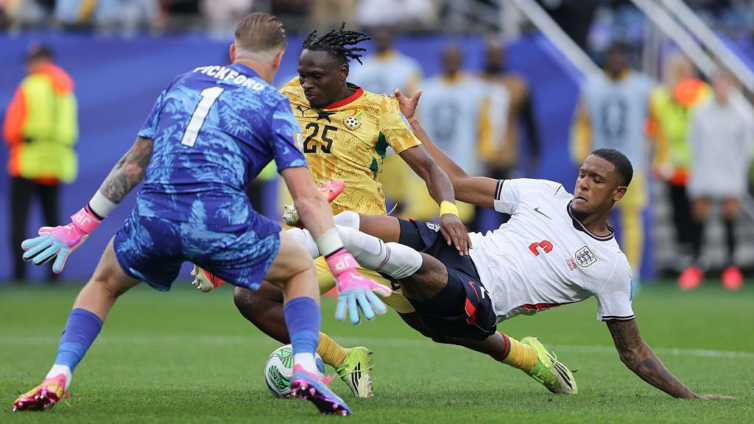
With the match still level at 0-0, Ghana substitute Prince Kwabena Adu found space and burst into the England penalty area.
The forward appeared to be in a promising position as he attempted to attack goal, but his run was interrupted by England defender Ezri Konsa.
As Adu moved into the box, Konsa launched into a challenge that immediately triggered appeals from Ghana’s players.
The Black Stars believed their striker had been brought down unfairly and expected referee Said Martinez to point to the penalty spot.
Instead, the Honduran official waved away the appeals and allowed play to continue.
The disappointment among Ghana’s players quickly turned to disbelief when VAR also chose not to intervene.
Despite reviewing the incident, the officials in the video operation room decided that the challenge did not warrant an on-field review.
The decision left Ghana furious.
Many supporters watching around the world were equally surprised.
Almost immediately, television replays began circulating online, prompting widespread debate about whether the Black Stars had been denied a golden opportunity to secure victory.
Carlos Queiroz Leads Ghana’s Frustration
Unsurprisingly, Ghana head coach Carlos Queiroz was one of the first people to express his frustration.
The experienced Portuguese manager did not hide his feelings after the match.
Queiroz questioned both the referee’s original decision and the role played by VAR.
Throughout the tournament, VAR has been promoted as a system designed to eliminate obvious mistakes and ensure fairness.
For Queiroz, the incident raised serious questions about whether the technology was being applied consistently.
The Ghana coach felt his side had been denied a clear penalty and suggested the officials had failed to use the available technology correctly.
His comments reflected the mood within the Ghana camp.
Players, coaches and supporters all felt that an important opportunity had been taken away from them.
Given the significance of the match and the potential impact on qualification, the frustration was understandable.
However, what happened next made the controversy even more interesting.
Wayne Rooney Believes Ghana Had a Penalty
One of the most notable voices to support Ghana’s argument was former England captain Wayne Rooney.
Rooney is one of the most respected figures in English football and remains England’s second-highest goalscorer of all time.
While analysing the match on BBC One, Rooney made it clear that he believed the referee had made the wrong decision.
“I think that’s a penalty,” Rooney said.
His assessment was direct and left little room for doubt.
According to Rooney, Konsa took a significant risk by attempting the challenge in the manner he did.
“Konsa takes a huge risk. His feet are off the floor when he comes flying in and he gets the man, not the ball.”
Rooney’s comments immediately attracted attention because he was speaking from an England perspective.
As a former England captain, many expected him to support the decision that benefited the Three Lions.
Instead, he chose to offer an honest assessment of what he saw.
His conclusion was clear.
Ghana had a legitimate penalty claim.
Micah Richards Also Questions the Decision
Former England defender Micah Richards echoed similar concerns.
Richards, who has become one of television’s most popular football analysts, also felt that England may have been fortunate.
While his comments were slightly more cautious than Rooney’s, he still acknowledged that Ghana had every reason to feel disappointed.
“On another day, that could have been a penalty,” Richards said.
Although Richards stopped short of saying the decision was definitely wrong, his observation reinforced the growing sense that the challenge was far more controversial than the officials appeared to believe.
His comments highlighted how divided opinion remains regarding the incident.
For many observers, the biggest surprise was not necessarily that the referee missed the challenge in real time.
Instead, it was the fact that VAR did not recommend a review.
Former World Cup Final Official Delivers Strong Verdict
Perhaps the most influential opinion came from Darren Cann.
Cann is not a former player or television pundit.
He is a former elite referee who officiated at the very highest level of the game.
Most notably, Cann served as an assistant referee during the 2010 FIFA World Cup final.
His experience gives him unique authority when discussing controversial refereeing decisions.
Unlike many former players, Cann understands precisely how officials are expected to interpret challenges inside the penalty area.
His verdict therefore carried significant weight.
Speaking after the match, Cann admitted he was pleased England had escaped punishment.
However, he also acknowledged that professional honesty required him to call the incident as he saw it.
“As an England fan I am delighted that it wasn’t given,” Cann admitted.
“But I have to be honest, for me this should have been referred.”
That statement alone was enough to generate headlines.
However, Cann went even further.
He offered a detailed explanation of why he believed the officials got the decision wrong.
“Konsa makes absolutely no contact at all with the ball. He brings down his opponent.”
“He is airborne, he is out of control, he makes contact with the attacker.”
“For me this was a penalty kick.”
Those words represented one of the strongest criticisms of the decision from anyone connected to English football.
Why Cann’s Opinion Matters
Cann’s comments are particularly important because they come from someone who understands both the responsibilities of referees and the operation of VAR.
Unlike supporters or former players, referees are trained to evaluate incidents according to the Laws of the Game.
When a former World Cup final official says a penalty should have been awarded, people naturally pay attention.
His criticism also extended beyond the referee on the field.
By saying the incident should have been referred, Cann was effectively questioning the performance of the VAR team as well.
That aspect of the controversy has become increasingly important.
Many observers accept that referees can miss incidents during the speed of a live match.
However, VAR exists specifically to identify clear and obvious errors.
For that reason, many people have focused their criticism on the failure to conduct an on-field review.
What the Decision Could Mean for Ghana
The frustration felt by Ghana is amplified by the potential consequences of the decision.
Had the Black Stars been awarded a penalty and converted it, they would likely have secured a famous victory over England.
Three points would have dramatically improved Ghana’s position in Group L.
The Black Stars could have booked their place in the knockout stages with a game to spare and approached their final group match against Croatia with significantly less pressure.
Instead, they were forced to settle for a draw.
While the point keeps Ghana’s qualification hopes alive, it also means there is still work to do.
The margin between success and disappointment at a World Cup is often incredibly small.
That reality makes controversial decisions even more painful.
Why the Debate Is Unlikely to Disappear
The discussion surrounding the penalty incident is unlikely to disappear anytime soon.
When a coach, former England internationals and a former World Cup final official all arrive at broadly the same conclusion, it becomes increasingly difficult to dismiss the complaints as simple frustration.
The controversy has also reopened wider conversations about the effectiveness of VAR and the consistency of refereeing decisions at major tournaments.
Supporters want clarity.
Players want consistency.
Coaches want confidence that obvious mistakes will be corrected.
In this case, many observers believe that did not happen.
Ghana Focused on What Comes Next
Despite the disappointment, Ghana must now shift attention towards their final group-stage challenge.
Carlos Queiroz and his players know they cannot change the referee’s decision.
What they can control is their performance moving forward.
The draw against England demonstrated that the Black Stars can compete with one of the tournament favourites.
Their defensive organisation, discipline and determination earned widespread praise.
Now they must build on that display and ensure the frustration from Boston becomes motivation rather than distraction.
Still, one question continues to linger over the match.
If Wayne Rooney, Micah Richards and Darren Cann all believe Ghana had a strong claim for a penalty, how did neither the referee nor VAR reach the same conclusion?
For many Ghanaian supporters, that question remains unanswered.
Share this: