
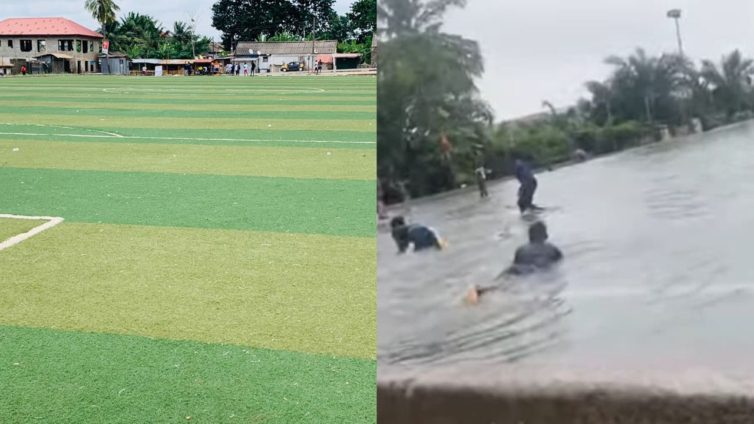
A modern artificial football pitch in Effiakuma, located in Ghana’s Western Region, was completely submerged in water over the weekend following hours of relentless rainfall in Takoradi. The incident has sparked public outrage and reignited longstanding concerns about inadequate drainage systems at newly constructed recreational facilities across the country.
In widely circulated videos that surfaced on social media, the artificial turf—funded by Ghana Gas and commissioned in 2018—was seen transformed into a virtual swimming pool. Dozens of residents, primarily children and teenagers, were seen wading through waist-deep water and even playing football in the flooded arena, turning what should have been a moment of concern into a surreal and sobering spectacle.
The footage was initially shared on Facebook by David Tetteh Botchway, a retired professional footballer and now coach at Adiembra Secondary School in Sekondi. Botchway also coaches Sedan FC, a lower-tier club that regularly trains at the facility.
A Facility Built With Promise, Now Drowning in Neglect
The Effiakuma astro turf was constructed in 2018 at a reported cost of $200,000, as part of Ghana’s broader push to develop grassroots football infrastructure. Funded through the Corporate Social Responsibility (CSR) initiative of Ghana Gas, the facility was hailed as a critical step in providing modern sports infrastructure to underserved communities.
At the time of its commissioning, then-Member of Parliament for Effia Constituency, Joseph Cudjoe, praised the initiative as a turning point in talent development.
“This is where the awakening of the national teams that we want will begin,” Cudjoe stated during the launch.
The astro turf officially opened for public use in 2020, offering a space for community clubs, school teams, and youth players to train and compete on a professional-grade surface. However, despite its potential, the facility has been plagued by recurrent flooding and drainage issues that critics argue could have been prevented with proper planning.
Drainage Flaws Exposed: “This Time, I’m Not Surprised”
Commenting on the recent flooding, Coach Tetteh revealed that the pitch has had a history of water-logging during rainy seasons. According to him, what happened last weekend was merely a more severe repetition of what locals have seen time and again.
“Usually, after a few hours of rain, the surface gets filled. This time, the rain lasted much longer, so I’m not surprised it was completely underwater,” Tetteh told Joy Sports.
The pitch was designed to be an all-weather facility, but it appears the drainage infrastructure is either faulty, poorly maintained, or completely inadequate for the intensity of rainfall the region periodically experiences.
Recurring Infrastructure Woes: A National Pattern?
This incident in Effiakuma is not isolated. Across Ghana, numerous artificial pitches, stadiums, and sports complexes constructed under state-funded or CSR-backed projects suffer from poor workmanship, lack of maintenance plans, and absence of climate adaptation features.
In recent years:
The Wenchi Astro Turf in Bono Region also experienced minor flooding.
The Madina Zongo pitch, constructed as part of the Zongo Development Fund, suffered erosion damage and turf peeling due to water stagnation.
Several community parks converted to astro turfs have reported inadequate perimeter fencing, non-functioning floodlights, and sinking surfaces due to poor substructure works.
These problems point to a troubling trend of infrastructure without sustainability—where pitches are built for political fanfare or PR visibility, rather than based on long-term usage, durability, and environmental factors.
Climatic Realities vs Engineering Oversight
Takoradi and its surrounding areas are known for heavy rainfall between May and August, a well-documented climatic pattern that should be factored into any construction project in the region. For a $200,000 facility to flood within five years of completion—despite predictable seasonal weather—is indicative of engineering oversight or inadequate planning.
Experts argue that modern astroturfs should be built with:
Multi-layered sub-base drainage systems
Proper sloping and gradient design
Run-off channels and collection chambers
Periodic maintenance to prevent silt blockage
The absence or failure of these components in Effiakuma is a reflection of cut corners, rushed timelines, or limited technical supervision during construction.
Children Swimming in a Flooded Pitch: Symbol of Systemic Failure
Perhaps the most distressing image was not the water itself, but the sight of children swimming and playing on the submerged pitch. What could have been a tragedy was treated as a novelty by young residents who, in the absence of safe recreational alternatives, viewed the flooded pitch as a temporary pool.
This speaks volumes about:
The absence of proper public safety education
Lack of alternative youth engagement avenues
Normalisation of failed public infrastructure
Instead of being protected by a functional facility, these children are exposed to potential drowning risks, waterborne diseases, and injury, all while playing on a pitch meant to uplift their future.
Accountability: Who Is Responsible?
With taxpayer money and CSR funding involved, the question of accountability cannot be avoided:
Was there any post-construction audit of the facility?
Who signed off on the drainage system design?
What role has the local Assembly or Municipal Planning Department played in facility maintenance?
There is an urgent need for the Ghana Gas Company, the Sports Ministry, and the Effia-Kwesimintsim Municipal Assembly (EKMA) to provide clarity on the infrastructure lifecycle of the pitch. Civil society groups are also calling for an independent technical assessment of all artificial pitches constructed since 2017 under similar CSR programs.
Fixing the Mess: What Needs to Be Done Now
To salvage the pitch and restore public trust in grassroots sports investment, the following immediate and long-term measures are essential:
Short-Term:
Drainage Audit and Emergency Repairs – Clear any existing blockages and retrofit basic run-off systems.
Community Engagement – Educate locals, especially children, on the dangers of playing on flooded surfaces.
Transparent Reporting – Publish findings on what went wrong and how it will be fixed.
Long-Term:
Drainage Engineering Standards – Enforce minimum construction standards for all recreational facilities.
Maintenance Budgeting – Allocate annual funds for cleaning, drainage checks, and minor repairs.
Stakeholder Monitoring – Include local football clubs, schools, and civil groups in monitoring facility conditions.
Conclusion: A Wake-Up Call, Not Just a Rainfall
The Effiakuma flooding incident must not be dismissed as a mere consequence of heavy rain. It is a glaring symbol of systemic negligence, poor planning, and wasted opportunity. Facilities like these were meant to nurture Ghana’s next generation of footballers—not turn into swamps at the first sign of seasonal weather.
If Ghana is truly serious about developing sports at the grassroots level, the country must go beyond ribbon-cutting ceremonies and slogans. It must invest in quality infrastructure, enforce accountability, and prioritize long-term maintenance.
Until then, the dream of finding the “next Michael Essien or Abedi Pele” from a community like Effiakuma will continue to sink beneath stagnant rainwater—just like the very pitch meant to unearth it.


