

Asante Kotoko striker Kwame Poku has addressed the growing controversy surrounding the decisive penalty that secured the club’s victory in the MTN FA Cup final against Golden Kick. The match, which ended in a 2-1 win for the Porcupine Warriors, was marked by a late penalty decision that has stirred significant debate among fans, pundits, and football stakeholders in Ghana.
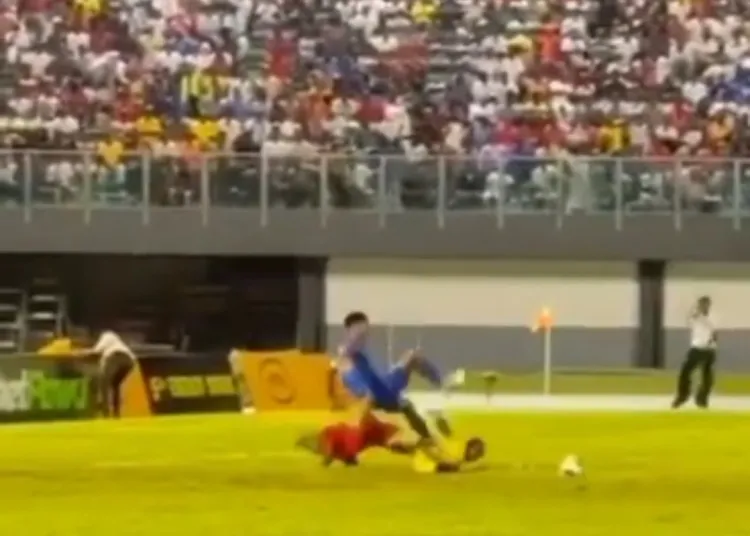
Speaking to 3Sports after the game, Poku described the play that led to the penalty as something he had intentionally worked on in training. “It’s something I’ve been doing,” he explained. “I’ve done it twice in training and it was late in the game, so I had to do something to bait the goalkeeper.”
Poku’s remarks have added a new layer to the debate, raising questions about whether the striker’s maneuver was a form of intelligent play or an act of gamesmanship. His statement suggests that he deliberately lured the goalkeeper into making a move that would result in contact, thereby winning the penalty. While this type of play is not uncommon in modern football, it often divides opinion, especially when it influences the outcome of a critical match.
The Incident
In the 89th minute, with the score level at 1-1, Kotoko launched a hopeful long ball into the Golden Kick penalty area. Poku, displaying characteristic pace and determination, chased after the ball as the Golden Kick goalkeeper rushed out in an attempt to clear it. What followed was a brief but crucial moment: the goalkeeper lunged for the ball, appeared to make some contact with it, and then collided with Poku, who fell to the turf. The referee, without hesitation, pointed to the penalty spot.
The decision instantly drew protests from the Golden Kick players and coaching staff, who argued that the goalkeeper had touched the ball first. Television replays supported this claim to an extent, showing that there was indeed a touch on the ball before the contact with Poku occurred. Critics argue that such a scenario should not result in a penalty, as the goalkeeper’s primary objective — to play the ball — was achieved before the foul.
However, others have noted that even if a goalkeeper touches the ball first, a reckless or dangerous follow-through that results in a foul can still be punished under the laws of the game. This grey area in football rules is what has kept the conversation alive and divided.
A Controversial Call
The aftermath of the decision saw Kotoko fans celebrate wildly, while supporters of Golden Kick and many neutral observers questioned the legitimacy of the call. Social media platforms, sports talk shows, and WhatsApp group chats were awash with opinions, analysis, and slow-motion breakdowns of the incident.
Former referees and football analysts have weighed in with varying takes. Some believe the referee made a justifiable call, citing the striker’s position and the nature of the contact. Others maintain that the goalkeeper’s initial touch on the ball should have nullified any suggestion of a foul, and therefore, the penalty should not have been awarded.
Regardless of the differing interpretations, the result stood. Poku converted the spot-kick with confidence, scoring his second goal of the evening and completing a brace that secured Kotoko’s 10th MTN FA Cup title. The victory added another trophy to the club’s illustrious history, but it also ensured that this particular final would be remembered for its controversial climax.
Reactions from the Football Community
The football community in Ghana has expressed a wide range of emotions following the match. Kotoko fans hailed Kwame Poku as a hero, praising his performance, work rate, and decisive goals. The brace not only delivered silverware but also re-established Poku as one of the club’s most valuable assets.
On the other hand, Golden Kick officials expressed disappointment with the officiating, calling for improved refereeing standards in the country. In a post-match interview, a member of the Golden Kick technical team stated, “We are proud of the boys and how they played, but we feel let down by the decision at the end. It’s unfortunate that a good game was decided by a call that many believe was wrong.”
Calls have been renewed for the introduction of Video Assistant Referee (VAR) technology in Ghanaian football, especially for high-stakes games such as domestic cup finals. While the Ghana Football Association has previously acknowledged the logistical and financial challenges of implementing VAR, incidents like this only add fuel to the demand for more accurate and fair decision-making tools.
Poku’s Role and Legacy
For Kwame Poku, the performance in the final has added another highlight to his career at Asante Kotoko. The forward has had an impressive season, and his ability to deliver in crucial moments has further endeared him to the club’s supporters.
When asked about the reaction to the penalty incident, Poku maintained that he acted within the spirit of the game. “As a striker, you look for opportunities. It was a split-second decision, and I did what I had to do,” he said. “Football is about moments, and that was mine.”
Poku’s comments, while candid, reflect the mindset of many modern attackers — to capitalize on any defensive lapse or overcommitment. His admission that he had practiced similar scenarios in training speaks to a level of preparation and awareness that is often required at the top level.
However, the broader football audience remains divided on whether such tactics should be celebrated or condemned. Some view it as a clever manipulation of the game’s mechanics, while others see it as a form of deception that undermines fair play.
Moving Forward
Asante Kotoko will now shift focus to the next season, buoyed by the momentum of their FA Cup triumph. The win has not only earned them a trophy but has also qualified them for continental football, offering another chance to test their mettle against Africa’s best clubs.
For Golden Kick, the narrow defeat will serve as a bitter pill to swallow, but also as motivation. Their performance against one of Ghana’s football giants showed resilience and potential, and with the right investment and development, they may soon become a regular contender in top-tier competitions.
The Ghana Football Association, meanwhile, faces renewed scrutiny over officiating standards. While human error is an inevitable part of the sport, high-profile incidents like this highlight the need for continuous referee education, accountability, and technological support.
Conclusion
Kwame Poku’s late penalty in the MTN FA Cup final may have secured victory for Asante Kotoko, but it has also sparked an intense debate about fairness, tactics, and officiating in Ghanaian football. As fans and analysts continue to dissect the incident, one thing is clear: football remains as unpredictable and emotionally charged as ever.
Whether viewed as clever strategy or controversial gamesmanship, Poku’s actions — and the referee’s call — have left an indelible mark on this year’s competition. For now, the Porcupine Warriors celebrate, while the debate over the penalty call continues to rage on.


